What does renewed instability in the Red Sea mean for Italian seafood?
There is currently no seafood supply crisis in Italy. However, renewed security risks around the Bab el-Mandeb Strait could once again alter shipping routes and transit times, particularly for products sourced from Asia, making logistics a key factor in procurement planning.
The renewed rise in tensions in the Red Sea does not currently amount to a supply crisis for the Italian seafood sector. It does, however, bring a concrete risk back into the planning of companies buying or selling products along the Asia-Europe trade corridor: if security conditions deteriorate, routes and transit times could change again.
The exposure is particularly evident for imports from certain Asian origins. On the export side, the risk also exists, but mainly for shipments bound for markets reached through Suez.
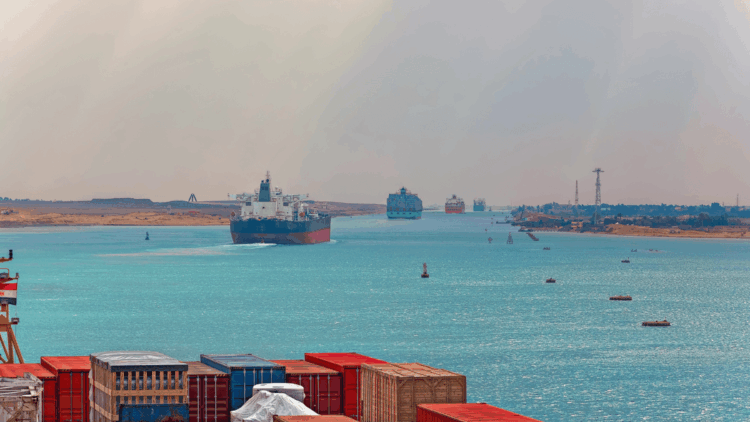
The return of major container services to the Suez Canal was expected to mark another step towards the normalisation of Asia-Europe shipping. Instead, it is taking place just as pressure is increasing again around the Bab el-Mandeb Strait and Italy is considering stronger protection for commercial navigation.
For the seafood industry, this deserves close attention. Not because there is already a seafood emergency, but because part of the supply reaching the European market originates in areas for which Suez is the most direct maritime connection with the Mediterranean. When that route becomes uncertain, logistics becomes a direct procurement variable.
Suez becomes central again just as risks increase
On 14 September, Maersk and Hapag-Lloyd announced that four Gemini Cooperation services previously routed around the Cape of Good Hope — AE5, AE11, AE12 and ME2 — would return to the trans-Suez corridor. Two other Gemini services were already using the route.
For Italy, the connection is direct. The AE11 service between Asia and the Mediterranean includes La Spezia, Genoa and Vado Ligure in its rotation, together with Shanghai, Yantian and Tanjung Pelepas. The ME2 service links India and Sri Lanka with Europe via Suez.
The operational plan published by Maersk therefore restores the Canal as a structural route for several major connections with the European market.
Four days later, Italian Defence Minister Guido Crosetto called for a larger naval presence to protect shipping in the Red Sea, while Italy was also preparing a possible national naval initiative. Reuters reported, citing Assarmatori, that around 40% of Italy’s trade with the rest of the world passes through the Suez Canal.
That figure refers to Italy’s overall international trade, not specifically to seafood, but it illustrates the economic importance of the route for the country.
For businesses, the key issue is the timing: shipping companies are restoring the shortest route between Asia and Europe just as the security conditions that make that route viable are becoming less predictable.
Squid shows where the Italian supply chain is actually exposed
Any assessment of the risk needs to avoid one important misconception: not all seafood imported into Italy passes through the Red Sea. Many of Italy’s main suppliers are European, while other products reach the country through entirely different routes.
There are, however, supply chains where links with Asia are significant.
Squid provides a concrete example. According to EUMOFA, Italy imported 34,864 tonnes of squid between January and September 2024, up 22% from the same period a year earlier. India alone accounted for 23% of Italian volumes, followed by Thailand and Argentina.
At EU level, the picture is even clearer. In 2024, the EU imported almost 225,000 tonnes of squid from non-EU countries, 98% of it frozen. India supplied 17% of these volumes, while Italy accounted for 21% of EU imports, ranking second behind Spain.
Squid does not represent the entire seafood market, but it clearly illustrates the relationship between product origin and route vulnerability. It is also a supply chain in which the complexity of international sourcing is already highly relevant from a traceability perspective, as highlighted by Pesceinrete’s analysis of illegal fishing and global squid supply chains.
Overall, EUMOFA data put the nominal value of Italian fisheries and aquaculture product imports in 2024 at around €7.6 billion. Salmon and tuna were the leading categories by value, while squid, octopus and shrimp together accounted for a significant share of purchases from abroad.
This figure does not show how much of those products actually travelled through Suez. It does, however, confirm how strongly the Italian market depends on an international sourcing network.
For businesses, the real issue is delivery predictability
The Red Sea issue is not simply about the cost of moving a container.
When a vessel has to change route, the first consequence for buyers is a loss of predictability. Longer transit times may require different inventory management, earlier purchasing decisions and a longer period during which both capital and goods remain tied up in the logistics chain.
This is particularly relevant in an industry where processors, wholesalers, retailers and foodservice operators work with planned product ranges and procurement requirements.
Maersk itself has justified the return through Suez on the basis of more efficient transit times, while making clear that further changes to its services will depend on continued stability in the Red Sea and the absence of further escalation.
That reversibility is itself becoming a commercial factor. A route can reopen and, if security conditions deteriorate, be changed again.
At present, however, there is no evidence allowing the renewed deterioration in security conditions to be linked to a general increase in seafood prices in Italy. Costs and consequences depend on origin, carrier, contract, port, product and shipping service. Claiming today that the entire seafood supply chain faces a certain price increase would mean anticipating an effect that has not yet been documented.
Imports and exports do not face the same exposure
Italy’s vulnerability is more immediately visible on the import side.
EUMOFA data show the strong reliance of the Italian market on international supplies and, for specific categories, the importance of Asian origins. A change in shipping connections through Suez can therefore directly affect procurement planning.
Exports require a different interpretation. In 2024, the main destinations for Italian fisheries and aquaculture product exports were Spain, Germany, France and Croatia. The largest trade flows recorded by EUMOFA therefore remain within Europe.
This does not remove the exposure of companies exporting to Asia, the Indian Ocean region or other destinations reached through Suez. It simply means that the same level of risk cannot be attributed to the entire Italian seafood export sector.
This distinction is precisely what makes the Red Sea a commercial issue rather than merely a geographical one.
For a seafood company, knowing the country of origin of a product is no longer enough. The port of loading, shipping service, planned route, available alternatives and the time buffer built into an order are increasingly relevant.
For operators assessing suppliers, products and commercial counterparts in the Italian market, the Italian Seafood Buyer Guide – IGB also provides a dedicated B2B reference point for companies and seafood products.
The logistics crises of recent years have transformed these factors from operational information into procurement strategy variables. The renewed deterioration in security around Bab el-Mandeb is occurring just as carriers are returning to Suez, highlighting how quickly the logistical advantage of the route can once again be called into question.
For the Italian seafood sector, the signal to watch is therefore clear: not a crisis already under way, but the return of shipping routes as a variable capable of determining the reliability and continuity of supply.