


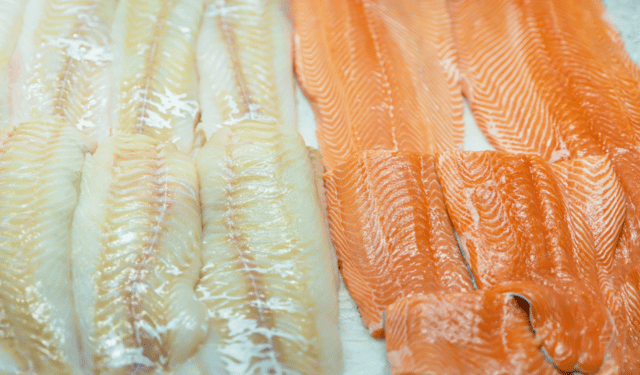

Italy remains one of the most important markets for Norwegian seafood products, particularly in categories that have traditionally underpinned national consumption: stockfish, salted cod, clipfish, and cod. Added to this is the increasingly strategic role of farmed salmon, now a structural component of the Italian offer across large-scale retail, foodservice, and specialised channels.
For this reason, Norwegian export dynamics — in terms of available volumes, ex-farm prices, priority destinations, and the balance between wild-caught and farmed products — have a direct impact on Italian supply chains, from importers and processors to final distribution.
In 2025, traditional products presented a complex scenario for operators dependent on Norwegian supply. Clipfish reached a record value of NOK 6.7 billion, despite a 9% decline in volumes. Salted fish climbed to NOK 2.5 billion in value (+18%), while stockfish recorded its lowest volume ever at 2,893 tonnes, constrained by persistently high prices throughout the value chain. These dynamics have strengthened the competitiveness of domestic Norwegian processing while reducing product availability for export markets, Italy included.
At the same time, farmed cod continued to gain ground. In 2025 it accounted for 38% of the export value of fresh cod, up from 28% in 2024 — a structural shift that is likely to prompt strategic reflection within the Italian market as well.
Salmon, a cornerstone of Italian demand, closed the year with exports of 1,414,909 tonnes valued at NOK 124.7 billion. Higher availability compared with previous years, combined with a softer average price, helped maintain stable supply to mature markets, including Italy.
This picture fits into a broader framework outlined by data released by the Norwegian Seafood Council, confirming that while 2025 was a record year in terms of export value, it was also marked by complex global dynamics affecting volumes, market shares, pricing, and destination priorities.
A Record Year for Norwegian Seafood in 2025
In 2025, Norway exported 2.8 million tonnes of seafood worth NOK 181.5 billion, an increase of NOK 6.4 billion compared with 2024 (+4%). This represents the highest level ever recorded, equivalent to approximately 38 million seafood meals per day. Growth was more moderate than during the post-pandemic boom of 2021–2023, when export values rose at exceptional rates.
Aquaculture and Fisheries: Value Growth, Diverging Volumes
Aquaculture now accounts for 73% of total export value and 54% of volumes, with 1.5 million tonnes exported for NOK 133.4 billion. Volumes increased by 13.1%, while value rose by 2%.
Capture fisheries represent the remaining 27% of value and 46% of volumes, totalling 1.3 million tonnes worth NOK 48.1 billion. Volumes declined by 12.5%, but value increased by 7%, driven by high prices for cod and mackerel.
A New Market Geography: Poland, the United States, and China
Europe remains the main destination region but saw its share of total export value fall from 67% to 63%. For the twelfth consecutive year, Poland was Norway’s largest market, with NOK 19.1 billion in imports, supported by its role as a processing hub for salmon and other species.
The United States confirmed growing interest, with a 19% year-on-year increase in value despite tariffs introduced in April and August, which raised duties on many products to 15% or more. Performance in 2025 was volatile: growth of 55% in the first quarter, 20% in the second, a slowdown to 6% in the third, and a slight decline in the fourth.
China recorded the strongest growth in value, up NOK 2.9 billion (+31%). With total imports of NOK 12.3 billion, it became Norway’s third-largest seafood market. Expansion was driven by more efficient e-commerce, improved distribution, and strong growth in consumption of salmon, shrimp, redfish, and Greenland halibut.
Salmon: Record Volumes and Expanding Markets
Salmon remains the backbone of Norwegian seafood exports, with 1,414,909 tonnes exported for NOK 124.7 billion (+2% in value, +13% in volume). Higher sea temperatures supported increased production and larger average fish sizes, enabling greater shipments to markets demanding large fish, particularly Asia and the United States.
China was the most dynamic market, reaching NOK 8.1 billion in value (+59%) and 90,906 tonnes in volume (+99%). Norway’s share of imported salmon in China rose from 41% to 57%.
Cod: Declining Wild Supply, Rapid Growth in Farming
Fresh cod exports totalled 36,704 tonnes for NOK 2.8 billion. Volumes fell by 9%, while value increased by 11%. Wild cod landings declined by 13%, but exports dropped even more sharply as a larger share of raw material was retained for domestic processing.
Farmed cod expanded rapidly, reaching 15,493 tonnes (+30%) valued at NOK 1.1 billion (+50%). Its share of the value of fresh cod exports rose to 38%, up from 28% in 2024.
Frozen cod reached 37,462 tonnes for NOK 3.2 billion. Volumes declined by 22%, while value increased by 5%. Vietnam and China remained key markets, with Vietnam benefiting from US–China tariff dynamics.
Clipfish, Salted Fish, and Stockfish: Record Values Despite Lower Volumes
Clipfish reached NOK 6.7 billion in value (+14%) despite a 9% volume decline. Salted fish climbed to NOK 2.5 billion (+18%) with volumes down 8%. Stockfish recorded its lowest volume ever at 2,893 tonnes but maintained a value of NOK 899 million due to very high prices.
Pelagic Species and Crustaceans: Rising Prices and Strong Demand
Herring increased in value to NOK 4.2 billion, with volumes down 8%, supported by growth in marinated products following the new EU customs agreement.
Mackerel reached NOK 8.5 billion. Volumes fell by 34%, but value increased by 2%. The average price for whole frozen mackerel exceeded NOK 50/kg for the first time, driven by reduced quotas and expectations of further cuts in 2026.
King crab closed at NOK 1.2 billion (+46%), snow crab at NOK 1.6 billion (+127%), both supported by strong volume growth. Shrimp reached NOK 1.8 billion (+12%) despite a 7% decline in volumes, reflecting the growing weight of ready-to-eat products and strong Asian demand.
A Record That Signals a More Competitive Phase Ahead
The 2025 results confirm the Norwegian seafood sector’s ability to generate value despite trade tensions, tariffs, currency appreciation, and reduced fishing quotas. At the same time, they point to a new phase in which raw material availability, global competition, and the growing role of aquaculture will define new balances in international markets.
For more insights on the future of Italian fisheries and the blue economy, follow ongoing coverage and analysis on Pesceinrete.