


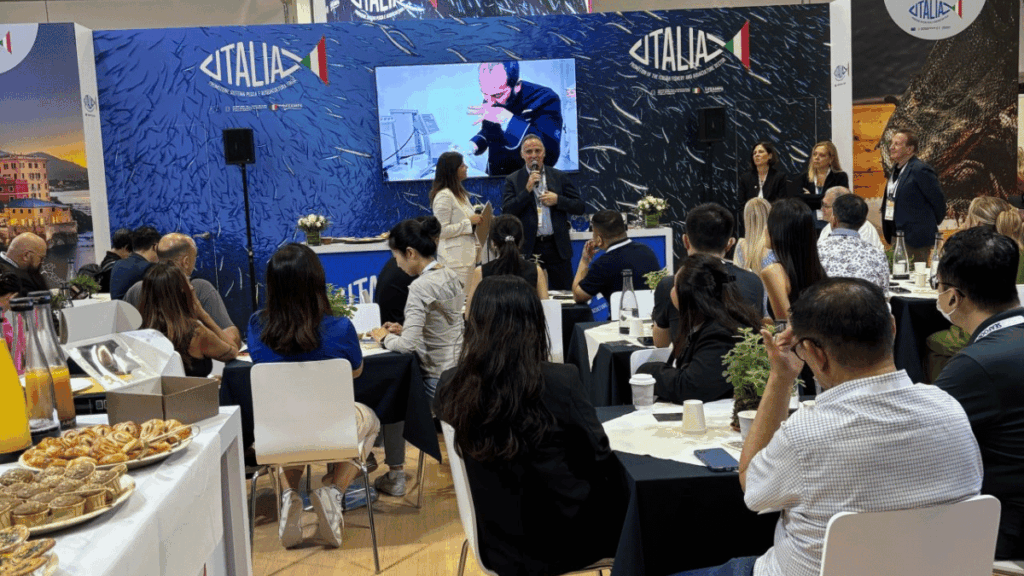

From blue crab seeking an industrial supply chain to traceable bivalve molluscs and red shrimp for fine dining, Italy is presenting Asian buyers with a seafood offer built around origin, processing and value creation. At Seafood Expo Asia in Singapore, the market is testing whether these attributes can translate into a concrete competitive advantage.
The presentations hosted at the Italian Pavilion at Seafood Expo Asia brought three tangible issues before Asian seafood operators: commercial outlets for blue crab, clear identification of origin and processing methods designed to increase product value. This is where the Italian Ministry of Agriculture, Food Sovereignty and Forestry’s mission to Singapore moves beyond institutional presence and faces the market test.
The institutional setting remains significant. The Italian Pavilion was inaugurated in the presence of Low Yen Ling, Singapore’s Senior Minister of State for Trade and Industry and for Culture, Community and Youth; Italian Ambassador Dante Brandi; Graziella Romito, Director General for Maritime Fisheries and Aquaculture at MASAF; and Roberta Cafiero, a Ministry official involved in managing EMFAF structural funds.
However, it is above all the experiences presented by companies and seafood operators that reveal the position Italy is seeking to build in the Asian market.
Blue crab enters the industrial phase
The clearest case comes from Goro.
Massimo Genari, General Manager of CO.PE.GO. – Consorzio Pescatori di Goro, presented the consortium’s blue crab sales figures in Singapore: 143,000 kilograms in 2024 and more than 460,000 kilograms in 2025.
These figures, supplied by the consortium, take on their full meaning when considered alongside the problem from which this activity emerged. Callinectes sapidus remains an invasive species that has severely affected shellfish farming in the Po Delta.
The increase in marketed volumes does not turn an environmental emergency into a success story. It does, however, show that removing the species can be combined with processing and market development, narrowing the gap between containment and the economic sustainability of the businesses involved.
This is the same issue highlighted in Pesceinrete’s analysis of the need to establish a stable blue crab containment supply chain: catching the crustacean is not enough if processing plants, industrial capacity, commercial continuity and reliable market outlets are missing.
CO.PE.GO.’s new plant and €15 million investment
The next step is industrial. CO.PE.GO. is building a new facility backed by a total investment of €15 million, including €11 million under Italy’s National Recovery and Resilience Plan.
The plant will also expand the consortium’s blue crab processing capacity and its ability to place the product on international markets. This is what makes the case relevant in Singapore: not simply selling an invasive species, but attempting to build an industrial structure capable of absorbing, processing and marketing larger volumes.
In other words, the market becomes one of the tools available to manage the problem. It cannot replace environmental containment, but it can help make that effort more economically sustainable.
Origin and processing become commercial assets
The second theme running through the Italian presentations concerns the ability to make seafood products clearly identifiable throughout the supply chain.
Daniela Borriello, National Head of Coldiretti Pesca, presented the “Firmato dai Pescatori Italiani” label, which focuses on identifying Italian origin. Finittica showcased its experience in controlled bivalve mollusc supply chains and organic production.
The two experiences are different, but the message to the market is similar: when a product is positioned through origin and quality, its provenance must be documented and communicated clearly to the buyer.
This is particularly important in Singapore, where reliance on international supplies makes food safety, source diversification and supplier reliability central concerns. According to the Singapore Food Agency, the country imports more than 90% of its food supply from over 180 countries and territories.
For exporters, therefore, Italian origin alone is not enough to secure a sale. It must be supported by supply-chain information, verifiable standards and the ability to ensure continuity of supply.
Red shrimp and fine dining: processing also shapes value
In the premium restaurant segment, Francesco Semeraro presented the Ammaruni brand for UENO. Other participants included Nicola Boccellato of Siciliana Fish, a Mazara del Vallo company specialising in the processing and marketing of seafood, with a particular focus on crustaceans and Mediterranean catches. Antonella Millarte, Global Marketing Director of Don Gambero, concentrated on Mediterranean crustaceans and processing methods.
In the case of red shrimp (Aristaeomorpha foliacea), two elements must be distinguished. The first is its origin in deep waters: Don Gambero reports that its product is caught at depths of around 700 metres. The second concerns the techniques used after capture: according to the company’s specifications, the shrimp is processed rapidly, without rinsing or glazing.
This may appear to be a technical distinction, but it has clear commercial relevance. In the premium segment, terms such as “quality”, “Mediterranean” and “red shrimp” carry greater weight when supported by verifiable information on species, fishing area, handling and preservation.
A show-cooking session by chef Simone Fraternali completed the journey from technical product specifications to the plate.
This is perhaps the most revealing picture to emerge from Singapore: Italy is not only testing Asian buyers’ appreciation of Italian seafood, but also identifying which characteristics they are genuinely willing to recognise and reward.
For blue crab, this means determining whether a commercial supply chain can support containment efforts. For molluscs and crustaceans, it means assessing whether origin, traceability and processing can become a tangible competitive advantage.