


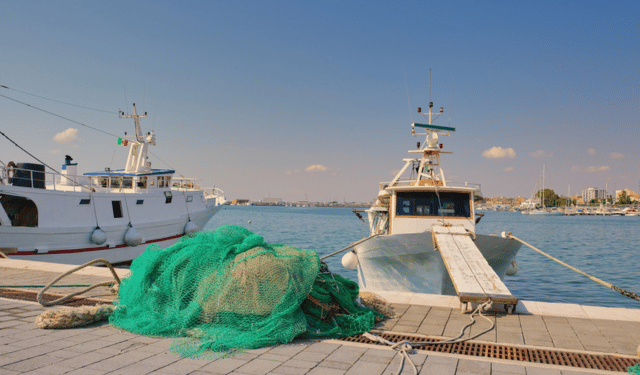

The Italian fishing sector challenges are becoming increasingly evident, as the industry faces a phase of strong structural pressure driven by a combination of economic, regulatory and market factors that are progressively undermining the operational sustainability of fishing businesses.
According to data processed by ISMEA, the sector is experiencing a decline in profitability linked to rising operating costs and the difficulty of transferring these increases along the supply chain. Among the main critical issues, fuel costs stand out as one of the most significant items in fishing companies’ budgets. In many cases, fuel can account for over 40–50% of daily operating costs, making it increasingly difficult to maintain adequate margins, especially in a context of fluctuating fish prices.
These pressures are compounded by increasingly complex market dynamics, characterized by strong competition from imported products, which are often more price competitive, and by distribution systems that tend to compress the value recognized to primary producers.
An additional critical factor is the regulatory framework. EU Regulation 1224/2009, which governs the fisheries control system, introduces increasingly stringent obligations for operators. In practical terms, for small-scale fishing enterprises this translates into daily requirements related to catch traceability, activity recording and compliance with structured control procedures, with a direct impact on work organization and operating costs.
Analyses by the STECF (Scientific, Technical and Economic Committee for Fisheries) highlight how the economic sustainability of Mediterranean fleets remains heavily influenced by these factors, with increasingly reduced margins for many businesses. In this context, support instruments such as the EMFAF (European Maritime, Fisheries and Aquaculture Fund) represent an important opportunity, but are often not fully accessible or effectively utilized by smaller operators.
Despite this scenario, there are concrete opportunities for recovery, which necessarily involve an evolution in both management and commercial approaches.
Strengthening the direct relationship with the market represents one of the main levers. From an operational perspective, this can translate into the introduction of simple direct sales models, such as weekly mixed fish boxes of 5–10 kg that can be ordered through direct channels (for example WhatsApp or local networks). These models reduce intermediation and can generate, in many cases, a margin increase of between 20% and 30% compared to wholesale sales.
At the same time, a qualitative leap in management practices is becoming essential. In practical terms, this means adopting even simplified control tools, such as digital onboard registers (tablets or dedicated applications), useful for monitoring fuel costs per trip, yield by species and profitability, enabling more informed and adaptive decision-making.
Another strategic element is the ability of operators to work collectively. In this direction, aggregation models such as shared landing platforms or coordinated sales systems for local catch are gaining relevance, allowing for logistics optimization and strengthening bargaining power in the market.
In this context, the future of the Italian fishing sector cannot rely exclusively on external interventions, but requires a gradual internal evolution of businesses, focused on greater economic awareness, improved management capacity and a stronger direct relationship with the market.