• HOME
  • CHI SIAMO
  • CONTATTI
  • PARTNER
  • PUBBLICITÀ
  • NEWSLETTER
  • ARCHIVIO
    • Bandi e Opportunità
    • Speciali
    • Rubriche
    • Nutrizione e salute
    • Interviste
    • Video
mercoledì 7 Ottobre, 2026
Pesceinrete
  • Pesca
  • Nutrizione e salute
  • Acquacoltura
    • Acquaponica
    • Algocoltura
  • Tecnologia
  • Sostenibilità
  • Mercati
  • Overseas
  • Guida BuyerNew
Nessun Risultato
Vedi tutti i Risultati
Pesceinrete
  • Pesca
  • Nutrizione e salute
  • Acquacoltura
    • Acquaponica
    • Algocoltura
  • Tecnologia
  • Sostenibilità
  • Mercati
  • Overseas
  • Guida BuyerNew
Nessun Risultato
Vedi tutti i Risultati
Pesceinrete
Nessun Risultato
Vedi tutti i Risultati

Home Overseas

From blue crab to red shrimp, buyers put Italy’s seafood supply chain to the test in Singapore

At Seafood Expo Asia, the focus shifts to supply-chain performance: CO.PE.GO. presents its blue crab model, Coldiretti Pesca and Finittica focus on origin and traceability, while UENO, Siciliana Fish and Don Gambero showcase Mediterranean crustaceans for Asia’s fine-dining market

Redazione by Redazione
9 Settembre 2026
in Overseas
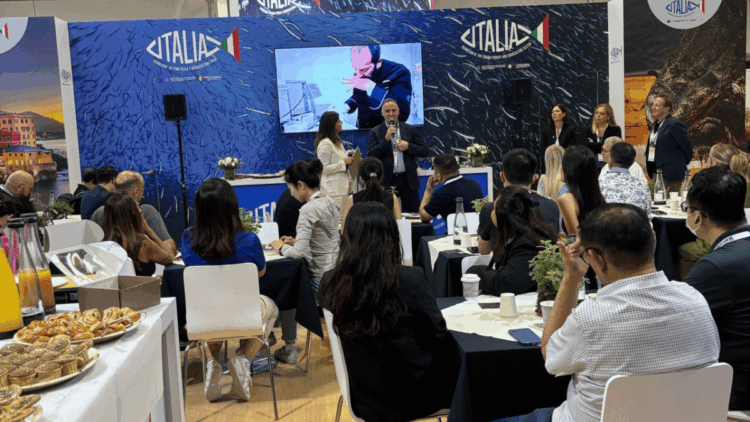
Italian seafood presented to buyers at Seafood Expo Asia in Singapore

Italian companies presented blue crab, bivalve molluscs and Mediterranean crustaceans to Asian buyers at Seafood Expo Asia in Singapore.

From blue crab seeking an industrial supply chain to traceable bivalve molluscs and red shrimp for fine dining, Italy is presenting Asian buyers with a seafood offer built around origin, processing and value creation. At Seafood Expo Asia in Singapore, the market is testing whether these attributes can translate into a concrete competitive advantage.

The presentations hosted at the Italian Pavilion at Seafood Expo Asia brought three tangible issues before Asian seafood operators: commercial outlets for blue crab, clear identification of origin and processing methods designed to increase product value. This is where the Italian Ministry of Agriculture, Food Sovereignty and Forestry’s mission to Singapore moves beyond institutional presence and faces the market test.

The institutional setting remains significant. The Italian Pavilion was inaugurated in the presence of Low Yen Ling, Singapore’s Senior Minister of State for Trade and Industry and for Culture, Community and Youth; Italian Ambassador Dante Brandi; Graziella Romito, Director General for Maritime Fisheries and Aquaculture at MASAF; and Roberta Cafiero, a Ministry official involved in managing EMFAF structural funds.

However, it is above all the experiences presented by companies and seafood operators that reveal the position Italy is seeking to build in the Asian market.

Blue crab enters the industrial phase

The clearest case comes from Goro.

Massimo Genari, General Manager of CO.PE.GO. – Consorzio Pescatori di Goro, presented the consortium’s blue crab sales figures in Singapore: 143,000 kilograms in 2024 and more than 460,000 kilograms in 2025.

These figures, supplied by the consortium, take on their full meaning when considered alongside the problem from which this activity emerged. Callinectes sapidus remains an invasive species that has severely affected shellfish farming in the Po Delta.

The increase in marketed volumes does not turn an environmental emergency into a success story. It does, however, show that removing the species can be combined with processing and market development, narrowing the gap between containment and the economic sustainability of the businesses involved.

This is the same issue highlighted in Pesceinrete’s analysis of the need to establish a stable blue crab containment supply chain: catching the crustacean is not enough if processing plants, industrial capacity, commercial continuity and reliable market outlets are missing.

CO.PE.GO.’s new plant and €15 million investment

The next step is industrial. CO.PE.GO. is building a new facility backed by a total investment of €15 million, including €11 million under Italy’s National Recovery and Resilience Plan.

The plant will also expand the consortium’s blue crab processing capacity and its ability to place the product on international markets. This is what makes the case relevant in Singapore: not simply selling an invasive species, but attempting to build an industrial structure capable of absorbing, processing and marketing larger volumes.

In other words, the market becomes one of the tools available to manage the problem. It cannot replace environmental containment, but it can help make that effort more economically sustainable.

Origin and processing become commercial assets

The second theme running through the Italian presentations concerns the ability to make seafood products clearly identifiable throughout the supply chain.

Daniela Borriello, National Head of Coldiretti Pesca, presented the “Firmato dai Pescatori Italiani” label, which focuses on identifying Italian origin. Finittica showcased its experience in controlled bivalve mollusc supply chains and organic production.

The two experiences are different, but the message to the market is similar: when a product is positioned through origin and quality, its provenance must be documented and communicated clearly to the buyer.

This is particularly important in Singapore, where reliance on international supplies makes food safety, source diversification and supplier reliability central concerns. According to the Singapore Food Agency, the country imports more than 90% of its food supply from over 180 countries and territories.

For exporters, therefore, Italian origin alone is not enough to secure a sale. It must be supported by supply-chain information, verifiable standards and the ability to ensure continuity of supply.

Red shrimp and fine dining: processing also shapes value

In the premium restaurant segment, Francesco Semeraro presented the Ammaruni brand for UENO. Other participants included Nicola Boccellato of Siciliana Fish, a Mazara del Vallo company specialising in the processing and marketing of seafood, with a particular focus on crustaceans and Mediterranean catches. Antonella Millarte, Global Marketing Director of Don Gambero, concentrated on Mediterranean crustaceans and processing methods.

In the case of red shrimp (Aristaeomorpha foliacea), two elements must be distinguished. The first is its origin in deep waters: Don Gambero reports that its product is caught at depths of around 700 metres. The second concerns the techniques used after capture: according to the company’s specifications, the shrimp is processed rapidly, without rinsing or glazing.

This may appear to be a technical distinction, but it has clear commercial relevance. In the premium segment, terms such as “quality”, “Mediterranean” and “red shrimp” carry greater weight when supported by verifiable information on species, fishing area, handling and preservation.

A show-cooking session by chef Simone Fraternali completed the journey from technical product specifications to the plate.

This is perhaps the most revealing picture to emerge from Singapore: Italy is not only testing Asian buyers’ appreciation of Italian seafood, but also identifying which characteristics they are genuinely willing to recognise and reward.

For blue crab, this means determining whether a commercial supply chain can support containment efforts. For molluscs and crustaceans, it means assessing whether origin, traceability and processing can become a tangible competitive advantage.
Tags: blue crabItalian seafoodred shrimpSeafood Expo AsiaSingaporetraceability
CondividiTweetCondividiPinInviaCondividiInvia
Articolo precedente

Pesca sportiva del tonno rosso, da oggi stop al trattenimento

Prossimo articolo

Sport paralimpico, 1,1 milioni alle società siciliane

Redazione

Redazione

Articoli Correlati

Seaweed cultivation and the development of Italy’s aquaculture supply chain

Seaweed, Italy’s supply chain still needs to be built

by Davide Ciravolo
7 Ottobre 2026

From the Adriatic to Liguria, projects launched in 2026 are bringing seaweed cultivation, shellfish farming and new industrial applications closer...

Satellite view of the Mediterranean Sea, the area analysed in the study on phytoplankton and surface chlorophyll

Mediterranean phytoplankton shifts as chlorophyll declines

by Candida Ciravolo
5 Ottobre 2026

Twenty-five years of satellite observations show less chlorophyll in surface waters and a shift towards smaller phytoplankton. The findings do...

Shopper looking at products in a supermarket freezer aisle

Friend of the Sea updates seafood labels and claims

by Luca Di Noto
2 Ottobre 2026

Friend of the Sea updates seafood labels and introduces a FOS ID. What the new anti-greenwashing rules mean for certification...

Mediterranean fisheries and multiannual management plans towards 2030

Mediterranean fisheries, multiannual plans towards 2030

by Federico Camilleri
30 Settembre 2026

From GSA 16 to the phase expected from 2027, management plans remain central to regulating fishing effort and catches while...

Lascia un commento Annulla risposta

Il tuo indirizzo email non sarà pubblicato. I campi obbligatori sono contrassegnati *

Questo sito utilizza Akismet per ridurre lo spam. Scopri come vengono elaborati i dati derivati dai commenti.


Articoli più letti

  • 10 pesci costosi e prelibati
  • Le specie di sarago del Mediterraneo
  • Pesci con più e meno mercurio
  • Molva, una ricchezza del Mare del Nord
  • Molluschi bivalvi: descrizione e caratteristiche
  • Congelare il tonno in scatola
  • Gattuccio e palombo, gli squali buoni da mangiare
  • Triglia: caratteristiche e proprietà nutrizionali
  • Mangiare il tonno crudo: vantaggi e pericoli
  • Sgombro e lanzardo, pesce azzurro per il cuore
Pesceinrete

Pesceinrete è la testata giornalistica unica in Italia ad occuparsi di pesca commerciale ed acquacoltura. In quanto canale tematico e dai contenuti specializzati, si rivolge direttamente agli operatori della filiera con una comunicazione targettizzata che risponde alle esigenze del settore.

Segui le nostre pagine social

Stock images by Depositphotos

Newsletter

Categorie

  • News Ittico
  • Pesca
  • Acquacoltura
  • Associazioni di categoria
  • Sindacati
  • ONG
  • Tecnologia
  • Sostenibilità
  • Mercati
  • Eventi e Fiere
  • Overseas
  • Nutrizione e salute
  • Approfondimenti
  • Chi siamo
  • Policy editoriali
  • Partner
  • Contatti
  • Pubblicità
  • Newsletter
  • Mappa del sito

© 2026 INRETE S.R.L. P.Iva: 02557660814 - Pesceinrete - Il quotidiano del settore ittico | Credits

Pesceinrete
Gestisci Consenso

Usiamo cookie tecnici per far funzionare il sito, e cookie statistici (anche di terze parti) per capire come viene usato e migliorarlo. Puoi accettare tutto, rifiutare tutto o scegliere quali attivare — restando comunque libero di navigare senza restrizioni.

Funzionale Sempre attivo
L'archiviazione tecnica o l'accesso sono strettamente necessari al fine legittimo di consentire l'uso di un servizio specifico esplicitamente richiesto dall'abbonato o dall'utente, o al solo scopo di effettuare la trasmissione di una comunicazione su una rete di comunicazione elettronica.
Preferenze
L'archiviazione tecnica o l'accesso sono necessari per lo scopo legittimo di memorizzare le preferenze che non sono richieste dall'abbonato o dall'utente.
Statistiche
L'archiviazione tecnica o l'accesso che viene utilizzato esclusivamente per scopi statistici. L'archiviazione tecnica o l'accesso che viene utilizzato esclusivamente per scopi statistici anonimi. Senza un mandato di comparizione, una conformità volontaria da parte del vostro Fornitore di Servizi Internet, o ulteriori registrazioni da parte di terzi, le informazioni memorizzate o recuperate per questo scopo da sole non possono di solito essere utilizzate per l'identificazione.
Marketing
L'archiviazione tecnica o l'accesso sono necessari per creare profili di utenti per inviare pubblicità, o per tracciare l'utente su un sito web o su diversi siti web per scopi di marketing simili.
  • Gestisci opzioni
  • Gestisci servizi
  • Gestisci {vendor_count} fornitori
  • Per saperne di più su questi scopi
Personalizza
  • {title}
  • {title}
  • {title}
  • Home
  • Nutrizione e salute
  • Pesca
  • Acquacoltura
  • Approfondimenti
  • Tecnologia
  • Sostenibilità
  • Mercati
  • Guida Buyer NEW
  • Overseas English
  • Archivio
  • Chi siamo
  • Contatti
  • Partner
  • Pubblicità
  • Newsletter
Nessun Risultato
Vedi tutti i Risultati

© 2026 INRETE S.R.L. P.Iva: 02557660814 - Pesceinrete - Il quotidiano del settore ittico | Credits