


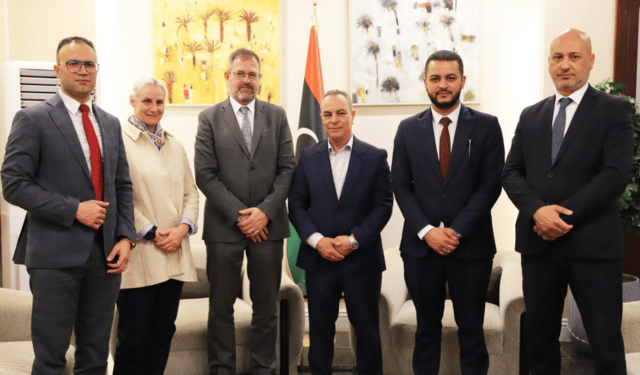

The Libya fisheries strategy GFCM visit marks a decisive step in the country’s transition toward a modern and sustainable blue economy. The official visit to Tripoli by a high-level delegation from the General Fisheries Commission for the Mediterranean goes far beyond a routine institutional meeting.
The encounter at Mitiga International Airport between international officials and the Ministry of Marine Resources of the Government of National Unity, represented by Deputy Minister Saber Alazabi, confirms Libya’s concrete intention to prepare—both technically and strategically—for the major challenges of marine sustainability and modern fisheries management.
The presence of GFCM Executive Secretary Miguel Bernal, alongside senior officials, underscores growing international attention toward the path that Tripoli is shaping within the fisheries and blue economy sectors.
In recent months, Libya has been sending increasingly clear signals: the sea is no longer viewed solely as a natural resource, but as a strategic asset for the country’s economic future. With one of the longest coastlines in the Mediterranean, Libya is now focusing on sustainable fisheries, aquaculture development, marine ecosystem protection, and the modernization of production chains.
The objective is twofold: to safeguard marine resources while transforming them into drivers of economic growth, employment, and food security.
Within this framework, Deputy Minister Saber Alazabi plays a pivotal role. His recent appointment as Vice-Chair of the General Fisheries Commission for the Mediterranean represents a significant political and technical milestone. It signals Libya’s increasing influence in Mediterranean decision-making processes and opens new avenues for multilateral cooperation.
Notably, Dr. Alazabi is expected to visit Mazara del Vallo on May 15–16, 2026, as part of a conference organized by Associazione Progetto Isola, held alongside the Mazara Narrativa e Poesia 2026. This event will provide a valuable opportunity to reassess relations between Italy and Libya, particularly in light of the mutual opportunities that enhanced cooperation could generate.
At the same time, initiatives such as the upcoming Zwara Fishing & Maritime Investment Expo demonstrate Libya’s intention to position itself as a modern and credible partner in the maritime sector. Trade fairs, international meetings, and technical missions all point to a clear strategic direction: transforming Libya into a regional hub for fisheries resources.
If this trajectory continues with consistency, Libya could soon emerge as a key player in both the European and global fisheries landscape. Its natural resources, strategic geographic position, and strengthening technical capabilities provide a solid foundation.
The recent meeting with the General Fisheries Commission for the Mediterranean is therefore more than diplomatic news—it is a symbol of a nation choosing to invest in its sea as a cornerstone for development, international credibility, and long-term growth.