



SeaWatch is an international project led by the University of Rome Tor Vergata that explores how fishing vessels can contribute to the monitoring of marine biodiversity. Through a small device called a metaprobe, placed inside fishing gear, vessels can collect environmental DNA during ordinary fishing operations. Combined with satellite data and artificial intelligence, these samples can help researchers, institutions and operators better understand marine ecosystems, sensitive areas and the pressures affecting Mediterranean fisheries.
A fishing vessel can also become a scientific tool. Not instead of research vessels, not outside official protocols, and not as a technological shortcut. But as part of a wider network, able to collect data on the sea while the sea is being experienced, crossed and worked every day.
This was one of the most interesting perspectives to emerge on 19 June at CNR–IRBIM in Mazara del Vallo, during the SEA4FUTURE stakeholder meeting, dedicated to the resilience of marine ecosystems through innovative technologies and an ecosystem-based approach to fisheries, with particular attention to the case of red shrimp.
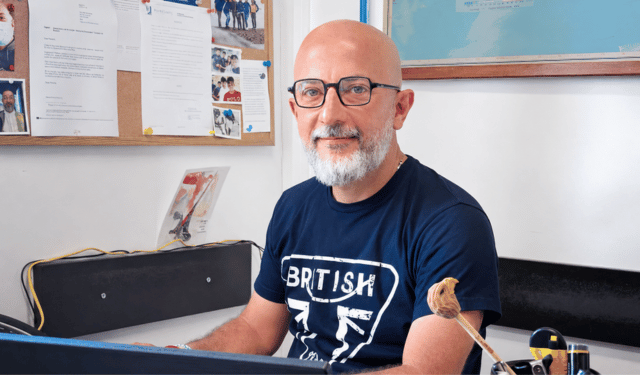
Within the session focused on technological innovation and sustainability in bottom trawling, Professor Tommaso Russo, from the University of Rome Tor Vergata, offered a concrete reflection on the digital monitoring of fisheries. The issue is not only the availability of new tools, but the way in which these tools can change the quality of information available to researchers, public decision-makers and operators.
Fisheries management needs better knowledge of the sea
In the Mediterranean, fisheries management operates within a delicate balance. On one side there are the economic needs of companies and fishing communities; on the other, the protection of stocks, habitats and the most vulnerable areas. Between these two dimensions lies a decisive question: the ability to know, with sufficient precision, what is happening at sea, where pressures are concentrated, how ecosystems are evolving and which signals deserve attention.
Illegal fishing, non-compliant activities, pressure on stocks and the management of sensitive areas remain complex problems. They require controls, rules, public responsibility and cooperation with operators. Technology alone cannot solve them. It can, however, reduce grey areas, make phenomena more readable and strengthen the ability to take decisions based on more solid data.
It is within this framework that SeaWatch takes shape. The international project, led by the University of Rome Tor Vergata, aims to turn fishing vessels into mobile sentinels of marine biodiversity, able to support research units in collecting information on ecosystems.
Fishing vessels do not replace research: they expand observation
This point is essential. SeaWatch does not propose replacing traditional scientific research, which remains fundamental for dedicated campaigns, protocol validation and data interpretation. Rather, it proposes expanding the sea’s observation capacity by bringing monitoring into the ordinary activity of fishing fleets.
Fishing vessels cross large portions of the sea every day, with a spatial and temporal continuity that scientific campaigns alone cannot guarantee with the same frequency. When included in a rigorous system, they can help collect valuable data, increasing monitoring coverage and strengthening the link between research and the productive sector.
This is the sense in which the reference, made during the presentation, to a democratic tool can be understood. Not as a generic formula, but as the democratisation of data collection. Knowledge of the sea does not remain limited to a few sampling moments or a few specialised platforms. It can also be fed by those who work at sea every day, within a controlled and shared scientific framework.
Environmental DNA changes the quality of monitoring
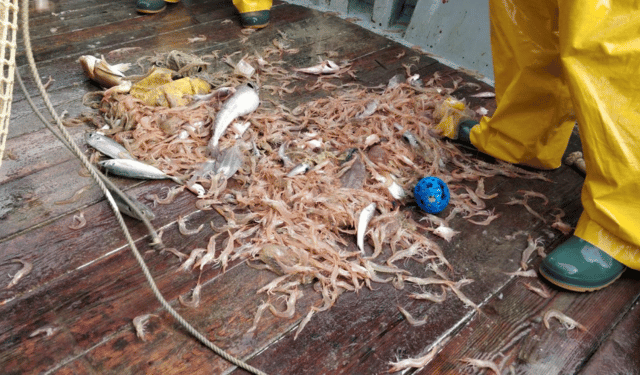
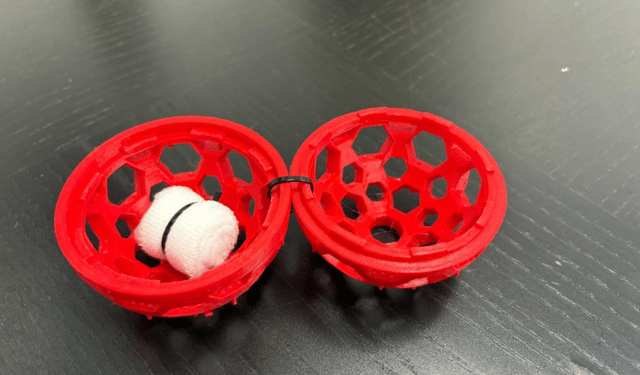
The technological core of the project is the metaprobe, a small device placed inside fishing gear during normal operations. While the net is working, the metaprobe passively collects traces of environmental DNA: the genetic material that marine organisms release into the water and surrounding environment.
This is where eDNA changes the quality of monitoring. Through metabarcoding, a sample can provide information on the presence of many species at the same time, even without catching them and without observing them directly. This makes it possible to broaden knowledge of marine biodiversity, identify areas of particular ecological interest, follow the evolution of ecosystems and detect signals linked to the presence of vulnerable, protected or alien species.
From biological samples to useful indicators
SeaWatch is not limited to collecting biological samples. The value of the project lies in the integration of information. Environmental DNA, satellite data and artificial intelligence models can be combined to build maps and indicators useful for marine management, from marine spatial planning to the assessment of protected areas and zones subject to fishing restrictions.
For the seafood supply chain, this shift in perspective is relevant. Fishers are not seen only as subjects to be controlled, but as active participants in a knowledge system. This does not reduce the need to combat irregular activities, but it enhances the role of fleets that operate correctly and can contribute to transparency, ecosystem protection and resource management.
Making pressures on the sea more visible also means making the work of those who respect the rules more recognisable. From this perspective, monitoring is not only control. It is shared responsibility, the ability to document, and the construction of trust between science, institutions and operators.
A new alliance between science, fisheries and institutions
The meeting in Mazara del Vallo had the merit of bringing this issue into a concrete scientific and institutional discussion. eDNA, satellites and artificial intelligence do not replace governance, but they can provide it with more effective tools. They do not erase the complexity of fisheries, but they help read it with greater precision.
The direction indicated by SeaWatch is clear: using the daily presence of fleets at sea to produce knowledge that is useful for conservation and management. A fishing fleet can also become a network of environmental sensors. Not to turn fishers into researchers, but to build a stronger alliance between research, fisheries and institutions.
An important part of the Mediterranean’s future depends on this alliance. Protecting the sea does not mean distancing fisheries from research, but bringing them closer within a model that is more transparent, more measurable and more responsible.