


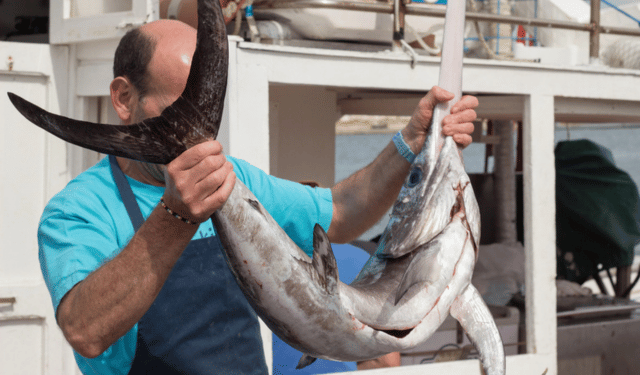

There is one development that risks going largely unnoticed, yet it could carry real weight for the future of swordfish fishing in the Mediterranean. Italy’s Ministry of Agriculture has launched a national trial on the use of trapline, a fishing gear that is still not widely used but is already drawing increasing attention from the international scientific community.
This is not just another regulatory update. It marks the official entry in Italy of a fishing system that will be observed, measured and tested through 2028, with a clear objective: to understand whether it can become a credible alternative, or at least a complementary tool, to the gears currently in use.
In its most common configuration, trapline consists of a structure made up of concentric rings fitted with hooks, bait and, in some cases, light devices. It does not replace longline gear, but works alongside it, coming into play at the most delicate stage of the activity: the moment when the actual catch is determined.
That is where the most interesting challenge begins.
For years, the sector has been dealing with a difficult balance: preserving the profitability of fishing businesses without increasing pressure on stocks, while at the same time reducing bycatch. Trapline is being studied precisely in this context. Its value does not lie in increasing volumes, but in improving catch quality by allowing better species selection and, above all, better size selectivity.
The ministerial decree does not open the door to unrestricted use of this gear. On the contrary, it establishes a strict pathway. Only a limited number of authorised vessels will be allowed to take part in the trial, and they will operate within a highly controlled framework, with precise obligations for data collection and continuous monitoring.
Every trip at sea will effectively become part of a research activity. Position, depth, gear configuration, number of hooks and catch composition will all have to be recorded. More than that, interactions with protected species will also be monitored, an issue that is becoming increasingly central in both European and international fisheries policies.
Supporting this framework will be a technical-scientific committee tasked with analysing the data and comparing the results with those obtained through traditional longline fishing. This is not a bureaucratic detail, but the core of the entire process. The real assessment of trapline effectiveness will depend on what emerges from this comparison.
For fishing operators, this is not a neutral development.
Those who join the trial will have to accept strict constraints, but they will also take on a direct role in a process that could shape future decisions. If the data show higher selectivity and lower bycatch, trapline could move beyond the experimental phase and become part of the management strategies for Mediterranean swordfish fishing.
If that happens, the balance of the sector could change.
It is still too early to draw conclusions, but one point is already clear: this is not just a technical test. It reflects the way Mediterranean fisheries are trying to respond to the environmental, scientific and regulatory pressures that have intensified in recent years.
As always, the real difference will be made by the data, and by how well the sector is able to interpret them.
Trapline is currently being tested in Italy as an experimental gear for swordfish fishing through 2028, with the aim of assessing its selectivity and environmental impact.
The trapline trial is part of wider internationally coordinated efforts to improve Mediterranean swordfish fishery management, with particular attention to reducing bycatch and strengthening the sustainability of fishing activities.