


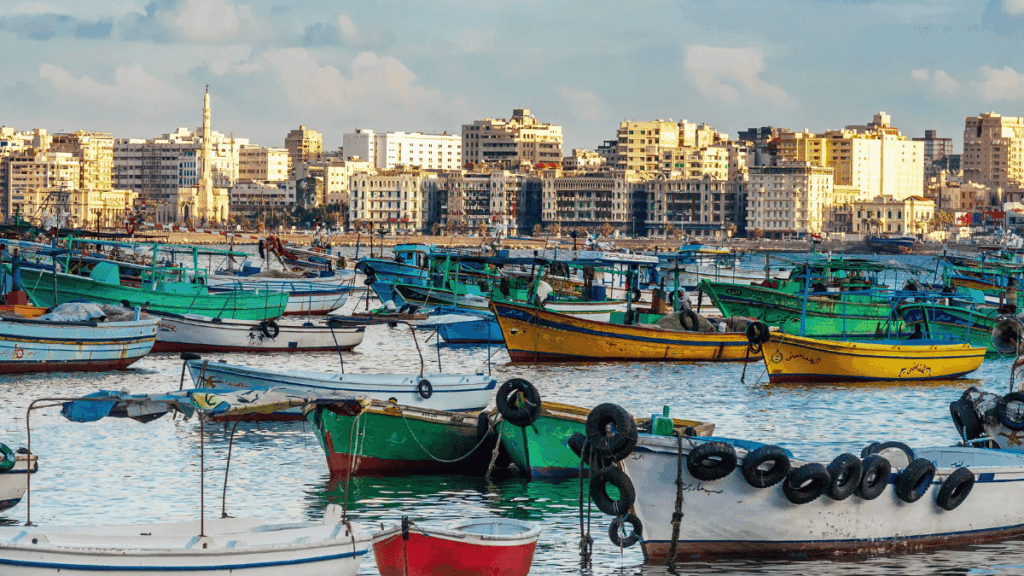

Fisheries data collection in Egypt is moving directly to the country’s ports. Four prefabricated, solar-powered offices equipped with basic laboratory facilities will record catch, fishing effort, discards, vulnerable species and socioeconomic information. Supported by the FAO’s General Fisheries Commission for the Mediterranean and funded by the European Union, the project aims to produce more complete and reliable data where the fleet operates.
Data collection where the catch comes ashore
The principle is straightforward: bring data collectors closer to fishers and to the places where catches are landed.
This need lies behind the pilot project launched by Egypt’s Lakes and Fish Resources Protection and Development Agency (LFRPDA), with the support of the General Fisheries Commission for the Mediterranean (GFCM), FAO Egypt and the European Union.
Four prefabricated units have been installed at fishing ports along Egypt’s Mediterranean coast. They will be more than administrative offices: the facilities will provide permanent operational bases for collecting and initially processing fisheries information, with basic laboratory equipment and solar power.
The aim is to reduce one of the most practical weaknesses of fisheries monitoring: the distance between the places where fishing takes place and those where the resulting data are subsequently organised and analysed.
Catch, discards and vulnerable species under observation
The new facilities will record catch volumes and fishing effort, alongside biological and socioeconomic information.
Monitoring will also cover discards and vulnerable species. These data are essential to understand not only how much is being caught, but also how fleet activity interacts with marine resources.
Working directly at landing sites should simplify sample transport, reduce logistical steps and encourage more regular exchanges among fisheries experts, fishers and local communities.
The expected outcome is a stream of data that is more continuous, better organised and more closely aligned with the day-to-day reality of fleet operations.
Better fisheries management starts with better knowledge
The Egyptian project addresses a central issue for the entire Mediterranean: fisheries decisions are only as robust as the data on which they are based.
Assessing stock status, measuring fishing effort and identifying emerging problems all require reliable and up-to-date information. This need spans the entire basin and lies at the heart of the debate surrounding the latest State of Mediterranean and Black Sea Fisheries report.
For industry operators, one point deserves emphasis: at present, the project does not introduce new obligations for fishers. Instead, it changes the system used to collect and organise information already required to monitor the sector.
The focus therefore shifts from simply increasing controls to measuring more accurately what actually happens at sea and in fishing ports.
A pilot model with potential to scale
The four offices were established under MedSea4Fish, the GFCM programme designed to strengthen the scientific and technical capacities of Mediterranean countries.
According to the FAO’s General Fisheries Commission for the Mediterranean, the new facilities will also act as a testing ground. They will help determine whether permanent port-based data collection can work effectively and potentially be replicated on a wider scale.
For now, this remains a pilot initiative rather than a fully validated model.
The underlying principle, however, is practical: better fisheries decisions require better information. Collecting that information directly in ports may be one of the simplest ways to bring fisheries data closer to the operational reality of the fleets.