


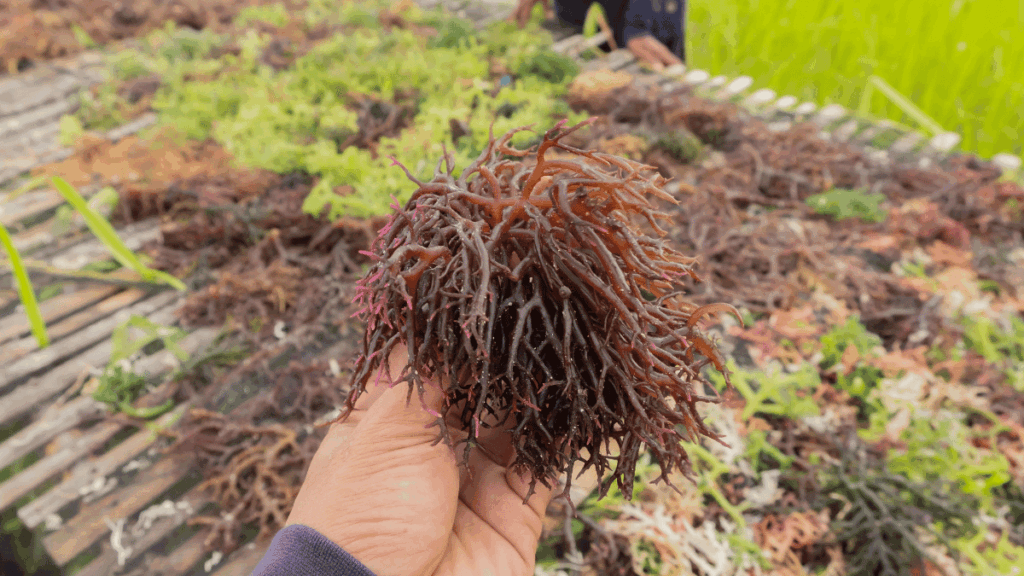
In 2026, several Italian projects are incorporating seaweed into integrated aquaculture systems and exploring ways to create industrial value from the resulting biomass. The next decisive step is to connect biomass producers, technology developers, processors and potential users.


Seaweed is becoming an increasingly tangible part of Italian aquaculture. The key question now is what supply chain can develop around its production, and which businesses and organisations can connect cultivation, processing and the market.
In September, at Emilia-Romagna’s fisheries and aquaculture forum, marine algae utilisation and the development of algae farming were identified as new opportunities for the sector. A few days earlier, results had been presented from BIOBASED, an Italy–Croatia project focused on integrating seaweed cultivation with mussels and oysters and creating value from the resulting biomass.
These developments should be considered together. The economic potential of seaweed depends on connecting cultivated species, biomass characteristics, production technologies, processing and industrial demand. This will determine whether seaweed can become a new business activity for parts of Italy’s aquaculture sector.
From trials to production
One of the most practical approaches involves aquaculture facilities already operating along the coast.
In Comacchio, the University of Ferrara’s BLUE-FARM project is testing an integrated multitrophic aquaculture system at three sites, where bivalve shellfish and native seaweed are farmed together. The seaweed is selected and propagated in university laboratories, while fishers and cooperatives participate directly in managing and monitoring the facilities.
The approach is particularly interesting from a production perspective: seaweed cultivation can be assessed as an addition to infrastructure, marine space and expertise already available in shellfish farming, potentially introducing another crop within the same marine area.
The Adriatic builds on existing resources
BIOBASED follows a similar approach. Coordinated by the University of Foggia and developed with partners including CNR-IRBIM and the Mediterranean Aquaculture Association, the project tested seaweed production through integrated multitrophic aquaculture systems and pathways for processing the biomass into higher-value products.
The relationship between production and commercial opportunities was already part of the discussion at AquaFarm 2026, when BIOBASED brought together researchers, businesses and industry professionals at the A.M.A. exhibition area to explore potential seaweed applications.
The results presented on 15 September added another element: cultivated seaweed can be used to develop pigments, biostimulants, fibres and biopolymers, through biorefinery processes designed to increase the value of the biomass produced.
Liguria is moving in the same direction. On 24 September, the University of Genoa presented RegenERA, a spin-off established to develop regenerative aquaculture models based on cultivating Mediterranean seaweed in IMTA systems, with the aim of supplying local, traceable biomass for the bioeconomy.
Individually, these projects differ. Together, however, they point towards a shared direction: integrating seaweed into existing marine activities and identifying which products can secure a stable market.
Value depends on connecting with the market
Cultivation is only one stage in the chain.
A report published on 24 July 2026 by the European Blue Economy Observatory on the potential use of seaweed in the food industry sets out the information businesses need: reliable raw material characteristics, functional performance, safety, regulatory compliance and the ability to incorporate the ingredient into scalable production.
This applies beyond food. Industrial users need to know what biomass they will receive, with which characteristics, in what quantities and with what consistency of supply.
From biomass to products, consistency matters
Analyses developed in 2026 under EU4Algae also identify the ability to scale up and achieve more consistent production as essential steps in developing European seaweed aquaculture.
Across Europe, the sector is still taking shape. The CINEA study supporting a sustainable EU algae industry, updated in May 2026, links its growth to the coordinated development of investment, regulation and industrial capacity.
This is where the Italian outlook becomes particularly interesting.
Shellfish farming can provide facilities, marine space and expertise. Research can select species and develop production protocols. Technology companies can make cultivation, harvesting and monitoring more efficient. Further along the chain, food, feed, agriculture, cosmetics, biotechnology and materials businesses can turn biomass into products with very different characteristics and values.
The supply chain starts to take shape when these stakeholders begin working on the same question: which seaweed should be produced, with what characteristics, in what quantities and for which market?
For an aquaculture business, this question comes before choosing a production system. For processors, it means defining raw material standards. For technology developers, it means designing systems that can ensure quality and consistency. For industrial users, it means identifying reliable suppliers and economically viable applications.
Italy’s projects in 2026 show that these stakeholders are beginning to connect. The next phase will be decisive: identifying which trials can become ongoing production and which applications can make that production economically viable.
This is the stage that will define roles and opportunities across Italy’s future seaweed supply chain. For producers, processors, technology developers and users of algal biomass, success will depend on establishing a practical connection from the outset between what the sea can produce and what the market is willing to buy.


