Overseas


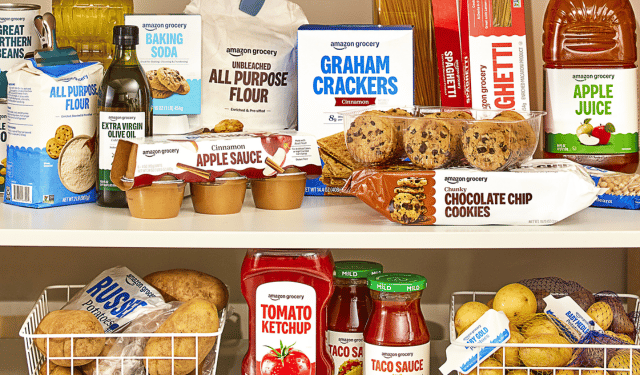
Just a few days ago, Amazon announced the launch of Amazon Grocery, a single brand uniting and replacing Amazon Fresh and Happy Belly — two private labels already familiar to the group’s customers.
The new brand offers over 1,000 food items — from pantry essentials to fresh products, meat, and fish — with most items priced under $5. The company’s stated goal is to deliver “quality and value without compromise” and make it easier for customers to discover Amazon-branded groceries.
The launch marks a significant expansion of the Seattle giant’s presence in the food sector, both online and across Amazon Fresh stores. It also represents a declaration of intent toward the global grocery market: Amazon aims to consolidate its fresh and packaged food offerings under one identity, in line with the steady growth of its grocery division. Seafood stands out among key categories, alongside meat, dairy, snacks, and bakery products.
Packaging plays a key role in the strategy. Amazon has reduced plastic use — for example, Amazon Grocery apple packs now contain 50% less plastic than before — and introduced clearer, more transparent designs to help customers make informed choices.
A new frontier for private labels
The initiative underscores Amazon’s ambition to strengthen its private label (MDD) strategy, already well established in home care, personal care, and baby care. With Amazon Grocery, the company takes private labels fully into the fresh food arena — a space traditionally dominated by brick-and-mortar retailers.
In the United States, where private label penetration remains lower than in Europe, Amazon aims to build trust and volume through its ecosystem: integrated logistics, consumption data, and a highly competitive price positioning. Each product is presented with an average rating above four stars — proof that verified reputation matters more than brand fame.
Amazon Grocery and the Italian seafood sector: a natural link
At first glance, a U.S. launch might seem distant from the Italian context. In reality, trends from across the Atlantic often anticipate shifts that later reach European markets. Amazon already operates Amazon Fresh in Italy’s main metropolitan areas, supported by a logistics network capable of same-day delivery for fresh and frozen goods.
If the Amazon Grocery format gradually expands to Europe, seafood will naturally rank among its core categories, alongside meat and dairy. The U.S. $5 pricing model would translate to target prices between €3.99 and €4.49 in Europe — with direct implications for canned, frozen, and ready-to-eat seafood segments.
For Italian producers, this means facing a new type of competition — not from discount chains, but from a global player combining convenience, logistics, and digital reputation. In this scenario, product value can no longer rely solely on origin or price, but also on differentiation through traceability, sustainable packaging, and authentic storytelling.
Price, quality, and sustainability: the competitive triangle
Across Europe, private label growth continues steadily: in 2024, store brands reached about 39% of total grocery value share, with Italy up by 2.4% year over year. Consumers increasingly recognize private labels for their compelling balance between quality and price.
Amazon positions itself as a new hybrid player — blending digital strength with the trust typically associated with global brands. For seafood, a category historically shielded by complex supply chains and specialized know-how, this marks its entry into mass online grocery retail.
The challenge for the Italian seafood supply chain is twofold: maintaining leadership in perceived quality and managing digital channels professionally. Every review, return, and consumer comment becomes part of a product’s value — as relevant as ASC, MSC, or FAO certifications. In other words, online reputation becomes a new form of traceability.
Outlook for the Italian seafood industry
For Italian producers of preserved and processed fish, the message is clear: it’s time to anticipate change. Those competing on price alone risk being absorbed into the market’s lower tiers, while those who can communicate origin, sustainability, and reliability will strengthen their position — even against a giant like Amazon.
The arrival of Amazon Grocery should not be seen as an immediate threat, but as a reminder: the battle for value in seafood now happens not just on supermarket shelves, but on consumers’ screens. Those who control the digital narrative — from product content to reviews — will define their market share tomorrow.
The world’s largest e-commerce operator has chosen to unify its food brand, placing seafood among its key categories. For the Italian supply chain, this is a clear signal: seafood is entering the new geography of global grocery, where price, sustainability, and reputation matter as much as — and sometimes more than — the label itself.
Stay informed — subscribe to our weekly newsletter for the most important seafood industry updates.