• CHI SIAMO
  • CONTATTI
  • PARTNER
  • PUBBLICITÀ
  • NEWSLETTER
  • ARCHIVIO
    • Bandi e Opportunità
    • Speciali
    • Rubriche
    • Nutrizione e salute
    • Interviste
    • Video
lunedì 20 Aprile, 2026
Pesceinrete
  • Home
  • News
  • Pesca
  • Acquacoltura
    • Acquaponica
    • Algocoltura
  • Protagonisti
    • Aziende
    • Istituzioni
      • Europee
      • Nazionali
      • Regionali
    • Associazioni di categoria
      • Associazione Mediterranea Acquacoltori
      • Legacoop Agroalimentare
      • Assoittica Italia
      • Federpesca
      • PescaAgri-CIA
      • Unci AgroAlimentare
    • Sindacati
      • UILA Pesca
    • ONG
    • Consorzi e Cooperative
      • CIRSPE
  • Tecnologia
  • Sostenibilità
  • Mercati
  • Eventi
  • OverseasNew
Nessun Risultato
Vedi tutti i Risultati
Pesceinrete
  • Home
  • News
  • Pesca
  • Acquacoltura
    • Acquaponica
    • Algocoltura
  • Protagonisti
    • Aziende
    • Istituzioni
      • Europee
      • Nazionali
      • Regionali
    • Associazioni di categoria
      • Associazione Mediterranea Acquacoltori
      • Legacoop Agroalimentare
      • Assoittica Italia
      • Federpesca
      • PescaAgri-CIA
      • Unci AgroAlimentare
    • Sindacati
      • UILA Pesca
    • ONG
    • Consorzi e Cooperative
      • CIRSPE
  • Tecnologia
  • Sostenibilità
  • Mercati
  • Eventi
  • OverseasNew
Nessun Risultato
Vedi tutti i Risultati
Pesceinrete
Nessun Risultato
Vedi tutti i Risultati

Home Overseas

Italy–Germany Talks Put Algae Aquaculture on the EU Agenda

In Rome, Ministers Lollobrigida and Rainer spotlight aquaculture—and algae—as a strategic bioeconomy value chain within the EU policy debate. Focus Keyphrase (long-tail)

Redazione by Redazione
27 Gennaio 2026
in Overseas
Italy–Germany Talks Put Algae Aquaculture on the EU Agenda

Italy–Germany Talks Put Algae Aquaculture on the EU Agenda

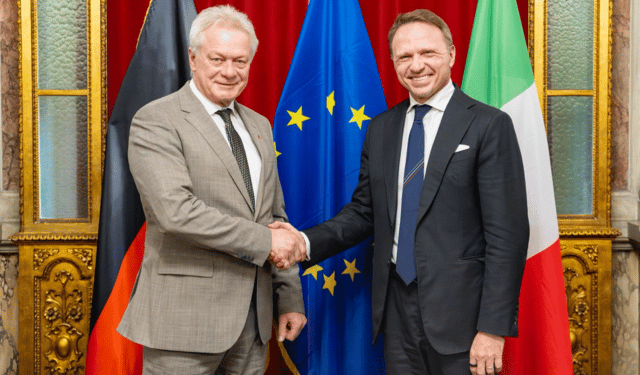
Italy-Germany algae aquaculture bioeconomy is the most notable takeaway from the meeting in Rome between Italy’s Minister of Agriculture, Food Sovereignty and Forestry, Francesco Lollobrigida, and Germany’s Federal Minister of Agriculture, Alois Georg Josef Rainer. While the bilateral talks fit within the broader framework of Italy–Germany relations, the explicit reference to aquaculture—and, more specifically, to algae as a strategic value chain for the bioeconomy—deserves close attention from the seafood sector.

Hosted at Italy’s Ministry of Agriculture (MASAF), the meeting reaffirmed the central role of cooperation between the two countries, with Germany described as Italy’s leading trading partner and the primary destination market for Italian agrifood exports. This relationship, built on strong integration across production and industrial supply chains, increasingly extends to aquatic production as well, as Europe’s demand grows for food security, sustainability, and competitiveness.

Discussions focused first on the Common Agricultural Policy and the post-2027 phase, with both ministers calling for a stronger strategic role backed by adequate resources, financial certainty, and governance aligned with member states’ specific structures—especially those with regionalized systems. Within this framework, they emphasized the need to continue decisively along the path of simplification and de-bureaucratization, benefiting both businesses and public administrations.

It is precisely within this broader reflection on European policies that aquaculture emerges as a meaningful signal. Its inclusion in a meeting centered on the CAP and regulatory streamlining is not a routine detail. Historically, aquatic production has held a marginal place in EU agricultural debates, despite being directly affected by European decisions on rules, investment priorities, and governance.

In the ministerial communication, attention turns specifically to the development of aquaculture and, in particular, to the algae segment, described as a high-potential sector and a necessary pillar for advancing the bioeconomy, with possible contributions to food security and the ecological transition. This should not be read as the announcement of an already structured industrial policy, but rather as a political marker: a gradual, clearer inclusion of aquatic value chains within Europe’s agrifood strategies.

The algae reference gains additional significance when viewed through the lens of Italy–Germany comparison. The two countries have followed different development trajectories. Over the years, Germany has invested more decisively in research and industrial applications for microalgae, while Italy remains strongly specialized in traditional aquaculture, with the algae segment still largely confined to a niche dimension. The bilateral discussion therefore suggests a shared awareness of the need to narrow this gap through a clearer regulatory framework and a more supportive European approach to sector development.

Other dossiers relevant to production supply chains were also addressed, including challenges in the phytosanitary sector and the need for a more flexible EU approach grounded in scientific evidence. The ministers also discussed the joint contribution of Italy and Germany to the simplification process of the EU Deforestation Regulation. While these issues fall into different policy areas, they collectively shape the regulatory environment in which aquaculture is expected to operate.

The meeting concluded with a shared intention to strengthen coordination between Rome and Berlin in EU and multilateral forums, promoting agricultural policies aimed at growth and competitiveness across Europe’s agrifood system. For the seafood and aquaculture sector, the message is clear: aquaculture—and within it, the algae value chain—is no longer treated as an ancillary topic, but as an increasingly integrated component of the European Union’s strategic choices.

For more insights on the future of Italian and European fisheries and the blue economy, follow ongoing coverage and analysis on Pesceinrete.
NEWSLETTER

Tags: algaeAquaculturebioeconomyCAP post-2027EU policyfood securityItaly Germany relationsMasafmicroalgaeregulatory simplificationseafood sectorsustainability
CondividiTweetCondividiPinInviaCondividiInvia
Articolo precedente

Pesca UE-Marocco: si riapre la rotta. A Rabat i negoziati per riportare la flotta in mare

Prossimo articolo

Salmone dell’Alaska, il 2026 è l’anno dei giganti

Redazione

Redazione

Articoli Correlati

EU maritime spatial planning and fisheries

EU maritime spatial planning and fisheries

by Alice Giacalone
17 Aprile 2026

Maritime spatial planning in the European Union is back at the center of the political agenda, with a message that...

Libya Fisheries Strategy: GFCM Visit Signals Blue Economy Shift

Libya fisheries strategy: GFCM visit signals Blue Economy shift

by Gaspare Bilardello
16 Aprile 2026

The Libya fisheries strategy GFCM visit marks a decisive step in the country’s transition toward a modern and sustainable blue...

Zwara Fishing Expo 2026: Libya’s Blue Economy Shift

Zwara Fishing Expo 2026: Libya’s Blue Economy Shift

by Gaspare Bilardello
14 Aprile 2026

In June 2026, the Zwara Fishing & Maritime Investment Expo marks a turning point in Libya’s fisheries sector, signaling a...

Trapline enters Italy’s swordfish fishery: why this trial matters

Trapline enters Italy’s swordfish fishery: why this trial matters

by Davide Ciravolo
13 Aprile 2026

There is one development that risks going largely unnoticed, yet it could carry real weight for the future of swordfish...

Prossimo articolo
Salmone dell’Alaska 2026

Salmone dell’Alaska, il 2026 è l’anno dei giganti

Lascia un commento Annulla risposta

Il tuo indirizzo email non sarà pubblicato. I campi obbligatori sono contrassegnati *

Questo sito utilizza Akismet per ridurre lo spam. Scopri come vengono elaborati i dati derivati dai commenti.

Categorie articoli


Newsletter

Pesceinrete

Pesceinrete è la testata giornalistica unica in Italia ad occuparsi di pesca commerciale ed acquacoltura.
In quanto canale tematico e dai contenuti specializzati, si rivolge direttamente agli operatori della filiera con una comunicazione targettizzata che risponde alle esigenze del settore.

Categorie

  • Pesca
  • Acquacoltura
  • Eventi e Fiere
  • Mercati
  • Sostenibilità
  • Tecnologia

Segui le nostre pagine social

Stock images by Depositphotos

  • Chi siamo
  • PARTNER
  • Contatti
  • Pubblicità
  • Newsletter

© 2023 INRETE S.R.L. P.Iva: 02557660814 - Pesceinrete- il quotidiano del settore ittico | Web design by Motion Head

  • Home
  • News
  • Pesca
  • Acquacoltura
  • Protagonisti
  • Tecnologia
  • Sostenibilità
  • Mercati
  • Eventi e Fiere
  • Overseas English NEW
  • Archivio
  • Chi siamo
  • Contatti
  • Partner
  • Pubblicità
  • Newsletter
Nessun Risultato
Vedi tutti i Risultati

© 2023 INRETE S.R.L. P.Iva: 02557660814 - Pesceinrete- il quotidiano del settore ittico | Web design by Motion Head