Overseas


The ocean continues to surprise us. Not only because it is changing, warming, losing biodiversity and facing growing pressure from human activities. The ocean also surprises us because it still holds forms of life that science had never formally described before. Some are microscopic, others live in the abyss, and others seem to come straight from a fantasy story. Yet they are real. They have a name, an evolutionary history and a role within the balance of marine ecosystems.
This is the meaning behind the new list published by the World Register of Marine Species, known as WoRMS, which has presented the ten most extraordinary marine species described by researchers in 2025. The selection was released for World Taxonomist Appreciation Day, the day dedicated to taxonomists: the scientists who collect, identify, compare, describe and give names to living species.
The news is not about new commercial species or new products destined for fish counters. It concerns something deeper: our knowledge of the sea. Every newly described species adds another piece to the understanding of oceans, their biological relationships and the fragile balances that often remain invisible until they are studied.
According to WoRMS, almost 2,600 new marine species were described and added to the register in 2025 alone, including around 660 fossil species. The Top Ten is therefore only a small selection from a much broader scientific effort that, every year, brings to light thousands of organisms that were still unknown or not formally classified.
Among the selected species are names that immediately capture attention. One is the “dragon nematode”, Dracograllus miguelitus, a tiny organism associated with deep-sea environments along the Mid-Atlantic Ridge. Its presence reminds us how little we still know about life on the seabed and how delicate these habitats are, especially in the face of growing interest in underwater mineral resources.
Then there is Eunice siphoninsidiator, nicknamed the “ambush sponge worm”. It is a deep-sea polychaete that lives inside the central cavity of a glass sponge and behaves like a predator lying in wait. It sounds almost like a piece of fiction, but it opens a window onto the complex relationships between different species in deep-sea environments.
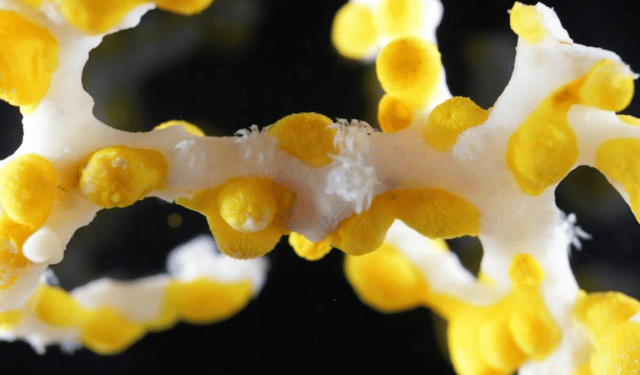
One of the most fascinating species on the list is Corallizoanthus aureus, a golden and bioluminescent zoantharian observed in deep marine caves in Japan. Its ability to emit green light is spectacular, but it is also scientifically relevant because it provides valuable information on the evolution of bioluminescence in marine organisms.
Also from the deep sea comes Photinopolynoe iskrae, the “glitter worm of Iskra”, found in extreme environments in the Pacific, among whale falls, sunken wood and methane seeps. These are places far removed from the common image of the sea, where life does not depend on sunlight but on chemical and bacterial processes. For this reason too, every newly described species in these contexts helps us better understand the extraordinary ability of life to adapt to extreme conditions.
Among the most curious names is Bathynomus vaderi, the Darth Vader supergiant isopod. It owes its name to the resemblance of its head to the famous helmet of the Star Wars character. But behind the pop-culture name lies a very concrete issue: the animal was already present in Vietnamese fish markets, even though science had not yet recognised it as a distinct species. This is one of the most interesting points for those who follow the seafood supply chain, because it shows that some organisms may be known through food use or commercial circulation before they are fully framed from a scientific point of view.
The Top Ten also includes Deltocyathus zoemetallicus, a stony coral that lives attached to polymetallic nodules in the abyss. This may sound like a technical detail, but it is central to the debate on the future of deep-sea floors. Those mineral nodules are considered potential resources for underwater extraction, but for some species they are also a real habitat. Removing the substrate may mean erasing the environment they need to survive.
Particularly significant is Mobula yarae, the Atlantic manta. The formal recognition of a new manta species in the Atlantic is not a purely academic step. It is essential for monitoring, protecting and managing the species with more precise scientific tools, especially when these animals are exposed to bycatch, vessel collisions, pollution and habitat loss.
Then there is Mobydickia poseidonii, Poseidon’s squid. Its story is one of the most surprising. Scientists recognised a new species, a new genus and even a new family from a specimen collected in the 1950s and preserved in a museum collection after being found in the stomach of a sperm whale. It is a case that highlights the importance of museums and biological collections, which are not static archives but scientific resources still capable of generating new knowledge.
The list closes with Kaikoja undume, a predatory abyssal tunicate that lives at around 3,000 metres below the surface. Here too, the name, inspired by the world of fantasy, should not distract from the scientific fact: the abyss hosts life forms that may seem alien, but fully belong to the evolutionary history of our planet.
News like this has a value that goes beyond curiosity. It reminds us that the sea is not only a productive resource, but a complex biological system, much of which is still unknown. Fisheries, aquaculture, processing, distribution and foodservice all depend, directly or indirectly, on the health of marine ecosystems. Understanding biodiversity more deeply also means building more serious tools to manage the relationship between human activities and the environment.
Taxonomy may seem like a discipline far removed from the daily life of the seafood sector. In reality, it is one of the foundations of science-based marine management. Without correct names, reliable classifications and shared data on species, it becomes more difficult to protect habitats, assess impacts, recognise pressures and distinguish what is known from what still remains to be discovered.
The WoRMS 2025 list tells us exactly this: the sea has not yet finished being known. And perhaps that is the most important news. At a time when oceans are often described only through crises, emergencies and conflicts of use, these ten species remind us that beneath the surface there is still an extraordinary heritage of life, relationships and mysteries.
Knowing it better is not a scientific luxury. It is an essential condition for respecting it, managing it and continuing to consider it a resource for the future.
Image credit: © 2026 Manabu Bessho-Uehara