• CHI SIAMO
  • CONTATTI
  • PARTNER
  • PUBBLICITÀ
  • NEWSLETTER
  • ARCHIVIO
    • Bandi e Opportunità
    • Speciali
    • Rubriche
    • Nutrizione e salute
    • Interviste
    • Video
giovedì 14 Maggio, 2026
Pesceinrete
  • Home
  • News
  • Pesca
  • Acquacoltura
    • Acquaponica
    • Algocoltura
  • Protagonisti
    • Aziende
    • Istituzioni
      • Europee
      • Nazionali
      • Regionali
    • Associazioni di categoria
      • Associazione Mediterranea Acquacoltori
      • Legacoop Agroalimentare
      • Assoittica Italia
      • Federpesca
      • PescaAgri-CIA
      • Unci AgroAlimentare
    • Sindacati
      • UILA Pesca
    • ONG
    • Consorzi e Cooperative
      • CIRSPE
  • Tecnologia
  • Sostenibilità
  • Mercati
  • Eventi
  • OverseasNew
Nessun Risultato
Vedi tutti i Risultati
Pesceinrete
  • Home
  • News
  • Pesca
  • Acquacoltura
    • Acquaponica
    • Algocoltura
  • Protagonisti
    • Aziende
    • Istituzioni
      • Europee
      • Nazionali
      • Regionali
    • Associazioni di categoria
      • Associazione Mediterranea Acquacoltori
      • Legacoop Agroalimentare
      • Assoittica Italia
      • Federpesca
      • PescaAgri-CIA
      • Unci AgroAlimentare
    • Sindacati
      • UILA Pesca
    • ONG
    • Consorzi e Cooperative
      • CIRSPE
  • Tecnologia
  • Sostenibilità
  • Mercati
  • Eventi
  • OverseasNew
Nessun Risultato
Vedi tutti i Risultati
Pesceinrete
Nessun Risultato
Vedi tutti i Risultati

Home Overseas

Packaging as a Strategic Lever: From Cost to Value Infrastructure

In a context marked by economic instability, inflationary pressure, and growing demand for transparency, packaging is no longer limited to containing and informing.

Davide Ciravolo by Davide Ciravolo
10 Febbraio 2026
in Overseas
Packaging as Value Infrastructure: Pricing, Trust and Innovation

Packaging as Value Infrastructure: Pricing, Trust and Innovation

For a long time, packaging sat at the center of a polarized debate, caught between its essential protective function and criticism related to environmental impact and material overuse. In recent years, however, the discussion has shifted toward a broader and more mature perspective, one that recognizes packaging as a strategic asset in value creation, price management, and the relationship between brands and consumers.

In a context marked by economic instability, inflationary pressure, and growing demand for transparency, packaging is no longer limited to containing and informing. It has become an integral part of the product offering itself—not as a decorative layer, but as a functional, communicative, and in some cases technological infrastructure capable of addressing new and documented needs.

A first area of evolution concerns the integration of price into the package itself. In several European retail experiences, price is no longer communicated as a temporary or promotional element, but is embedded directly into packaging design. This approach, often referred to as Brand Price Pack, aims to convey a sense of long-term stability and affordability, clearly differentiating itself from short-term discount-driven strategies.
The *Price Packs introduced by PENNY in Germany are frequently cited in industry literature as a case study in using packaging to reinforce consumer trust during periods of strong price volatility.

Alongside the economic dimension, packaging is also reclaiming and expanding its protective role through technological innovation. Applied research on materials and labels has led to solutions that improve product preservation and reduce risks associated with use and consumption. A documented example is the Fridge Label developed by Groupe MAG in collaboration with the agency LG2. This refrigerating label, based on insulating silica aerogel, is designed to maintain suitable temperatures for longer periods under critical conditions. In this case, packaging directly contributes to risk management without altering product formulation.

A similar approach, applied in the healthcare sector, can be found in the photoluminescent labels introduced in Puerto Rico by Farmacias Plaza in partnership with Alivia Health. Designed to glow in the dark, these labels were created to reduce medication errors in a context characterized by frequent power outages. According to industry analyses released after the project received recognition at the Cannes Lions 2025, the initiative achieved rapid adoption and measurable impact on prescriptions—demonstrating how packaging can take on a public service function.

At the same time, packaging continues to play a central role in brand identity building, but in increasingly structured ways. Several recent projects show how packaging can function as a coherent narrative system without sacrificing clarity or usability. The Good To Read Packs project by Bennet, for example, integrates literary excerpts on everyday consumer goods, building on documented insights into how consumers engage with nutritional and cultural information. In this case, packaging becomes an additional brand touchpoint without altering the product’s primary role.

The visual identity refresh of Domino’s Pizza, launched after more than a decade of graphic continuity, also placed packaging at the core of its strategy, using it to enhance recognition and consistency across the consumption experience. In the preserved foods segment, the rebranding of Pomilia illustrates how packaging can act as a tool of continuity, preserving historical elements while translating them into a contemporary visual language across a broad product portfolio.

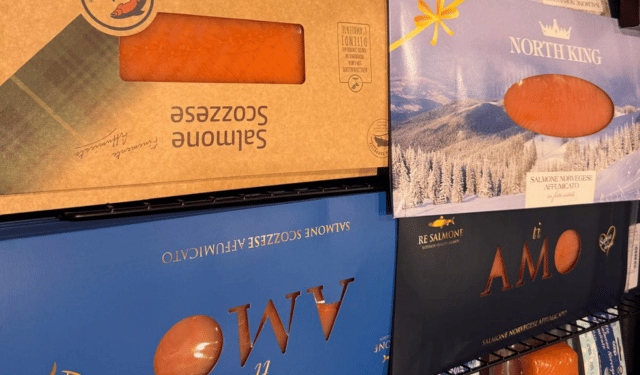
Despite differences in sector and objectives, these cases converge on a common conclusion: packaging is no longer merely an operational cost, but a design lever capable of generating measurable value. For the seafood sector as well—where safety, preservation, and transparency requirements are particularly stringent—packaging represents a tangible space for innovation. Beyond environmental sustainability, today’s challenge increasingly concerns the economic and relational sustainability of products in the marketplace. In this scenario, packaging stands out as one of the most relevant tools available to companies.

PENNY’s Price Packs (Germany) are a packaging campaign for private-label products in which the pack itself becomes a large price tag: minimal graphics and a prominently printed price as the dominant visual element.

For more insights on the future of Italian and European fisheries and the blue economy, follow ongoing coverage and analysis on Pesceinrete.
NEWSLETTER

Tags: brand strategyconsumer trustfood industryhealthcare packaginginnovationpackagingpricingretail
CondividiTweetCondividiPinInviaCondividiInvia
Articolo precedente

Indo Fisheries Expo & Forum 2026, dal 16 al 18 giugno a Tangerang

Prossimo articolo

Il tonno nel mondo: cosa raccontano oggi i dati più aggiornati

Davide Ciravolo

Davide Ciravolo

Articoli Correlati

The sea still has secrets: WoRMS reveals the most extraordinary marine species of 2025

The sea still has secrets: WoRMS reveals the most extraordinary marine species of 2025

by Davide Ciravolo
14 Maggio 2026

The ocean continues to surprise us. Not only because it is changing, warming, losing biodiversity and facing growing pressure from...

Bottarga and Grey Mullet: when wesearch supports Mediterranean aquaculture

Bottarga and Grey Mullet: when wesearch supports Mediterranean aquaculture

by Tiziana Indorato
13 Maggio 2026

Bottarga and grey mullet are closely linked to one of the most recognizable products in Mediterranean seafood culture. Bottarga belongs...

EU fisheries and aquaculture statistics: why better data matter

EU fisheries and aquaculture statistics: why better data matter

by Tiziana Indorato
12 Maggio 2026

There is a part of fisheries and aquaculture that cannot be seen in ports, fish markets, farming sites or processing...

Central Mediterranean: fisheries, security and cooperation at the heart of the debate in Mazara del Vallo

Central Mediterranean: fisheries, security and cooperation at the heart of the debate in Mazara del Vallo

by Redazione
11 Maggio 2026

The Central Mediterranean is not merely a geographical space. For Mazara del Vallo, it means work, memory, identity and, often,...

Prossimo articolo
Global Tuna Stock Status 2026: What the ISSF Report Really Says

Il tonno nel mondo: cosa raccontano oggi i dati più aggiornati

Lascia un commento Annulla risposta

Il tuo indirizzo email non sarà pubblicato. I campi obbligatori sono contrassegnati *

Questo sito utilizza Akismet per ridurre lo spam. Scopri come vengono elaborati i dati derivati dai commenti.

Categorie articoli


Newsletter

Pesceinrete

Pesceinrete è la testata giornalistica unica in Italia ad occuparsi di pesca commerciale ed acquacoltura.
In quanto canale tematico e dai contenuti specializzati, si rivolge direttamente agli operatori della filiera con una comunicazione targettizzata che risponde alle esigenze del settore.

Categorie

  • Pesca
  • Acquacoltura
  • Eventi e Fiere
  • Mercati
  • Sostenibilità
  • Tecnologia

Segui le nostre pagine social

Stock images by Depositphotos

  • Chi siamo
  • PARTNER
  • Contatti
  • Pubblicità
  • Newsletter

© 2023 INRETE S.R.L. P.Iva: 02557660814 - Pesceinrete- il quotidiano del settore ittico | Web design by Motion Head

  • Home
  • News
  • Pesca
  • Acquacoltura
  • Protagonisti
  • Tecnologia
  • Sostenibilità
  • Mercati
  • Eventi e Fiere
  • Overseas English NEW
  • Archivio
  • Chi siamo
  • Contatti
  • Partner
  • Pubblicità
  • Newsletter
Nessun Risultato
Vedi tutti i Risultati

© 2023 INRETE S.R.L. P.Iva: 02557660814 - Pesceinrete- il quotidiano del settore ittico | Web design by Motion Head