Overseas


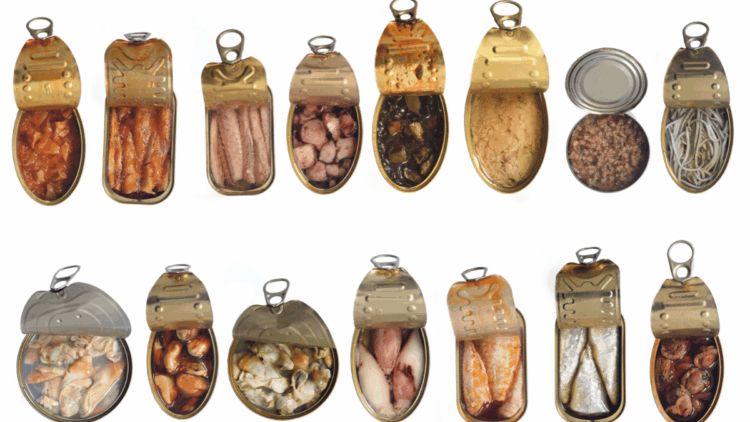
Among the products identified on the Italian online market, a 400 g tin of Chatka red king crab is priced at €131.99. Los Peperetes sea urchin roe costs €71 for 120 g, equivalent to €887.50/kg when calculated on the declared 80 g drained weight. Among Italian products, Testa Conserve bluefin tuna fillets in a 620 g pack are priced at €65, while a 350 g tin of Carloforte Tonnare bluefin tuna ventresca costs €42.
There is no official ranking of Italy’s most expensive canned seafood products. These figures should therefore be considered a snapshot of selected products available online at the time of the survey.
Thinking of canned seafood as an inherently inexpensive category is increasingly misleading. Alongside everyday tins designed for mass consumption, there is a much smaller premium segment where species, cut, origin, raw-material availability and processing methods push prices into an entirely different range.
A tin of king crab can cost more than €130. Just 120 grams of sea urchin roe can reach €71. Premium Italian bluefin tuna cuts can sell for several tens of euros per pack.
The headline prices are striking, but they reveal something more relevant for the seafood industry: preservation can become a tool for retaining and increasing the value of high-value seafood raw materials.
How much does premium canned seafood really cost?
The highest pack price found in the survey was for Chatka red king crab, sold in a 400 g tin containing 280 g of drained product, at €131.99.
Calculated on the drained weight, this corresponds to approximately €471/kg.
The case of Los Peperetes sea urchin roe from Galicia is even more remarkable. The 120 g tin is priced at €71, while the declared drained weight is only 80 g. That takes the price from around €592/kg based on net weight to €887.50/kg of drained product.
Processing helps explain this positioning. According to the retailer’s product information, the roe is manually extracted and processed during a limited seasonal window, between January and March.
On the Italian side, Testa Conserve bluefin tuna fillets are offered in a 620 g pack at €65, while Carloforte Tonnare ventresca costs €42 for 350 g. In the latter case, the declared drained weight is 240 g, bringing the value to approximately €175/kg of drained product.
Pack price can be misleading
A simple ranking based only on shelf price would tell only part of the story.
Comparing a 120 g tin with a 400 g or 620 g pack without considering the amount of edible product can produce a distorted picture.
Among the products examined, the hierarchy changes significantly when price is calculated against quantity:
- Los Peperetes sea urchin roe: €887.50/kg drained weight
- Chatka red king crab: approximately €471/kg drained weight
- Carloforte Tonnare bluefin tuna ventresca: approximately €175/kg drained weight
- Testa Conserve bluefin tuna fillets: approximately €105/kg net weight
This is not a quality ranking. The species, processing methods and pack formats are too different for that type of comparison.
What the figures do show is how wide the value range can become within the canned seafood category.
Why sea urchin roe, king crab and ventresca cost so much
The reasons vary considerably from one product to another.
With sea urchin roe, price is influenced by the relatively small proportion of edible product, seasonality and the delicate processing required.
With king crab, the economics are driven mainly by the high value of the raw material and by the selection of the meat marketed in the final pack.
For bluefin tuna, the specific cut also matters.
Ventresca comes from the fatty belly section of the fish and is characterised by a higher lipid content. It is traditionally regarded as one of the most prized tuna cuts.
The ability to separate and market individual cuts according to their different characteristics allows processors to create products occupying very different commercial price points from the same species.
At this level, preservation is no longer simply functional.
It becomes a way of ensuring that a specific species, origin, cut and processing method remain identifiable all the way to the final sale.
The real question is how much value remains in the seafood supply chain
The €131.99 king crab tin attracts attention, but it certainly does not represent Italy’s canned seafood market as a whole.
This is an extreme niche, far removed from the volumes handled by mainstream retail.
For seafood operators, the more interesting signal is that a preserved seafood product can reach several hundred euros per kilogram when buyers and consumers recognise — and are willing to pay for — a clearly identifiable difference in the raw material.
Bluefin tuna is particularly relevant from an Italian perspective.
Economic value is not generated solely through fishing. It also depends on cut selection, processing, traceability, positioning and marketing.
The same principle is increasingly relevant to the wider development of Italy’s bluefin tuna supply chain, where greater integration between harvesting, processing and commercialisation can help retain a larger share of the value generated by the resource. Italy’s 2026–2028 bluefin tuna framework also reinforces the role of traceability and planning throughout the national supply chain.
The difference between an ordinary tin and a seafood product worth hundreds of euros per kilogram therefore does not lie in the container itself.
It lies in the ability of the supply chain to make species, origin, cut and processing clearly recognisable even after preservation.
When that information survives all the way to the finished product, canning does more than extend seafood shelf life.
It can also preserve its economic value.