Overseas


The issue, therefore, is not merely commercial. It is a matter of product recognition and of protecting a supply chain that has been built over time around a unique natural resource.
In public debate, one simplification appears again and again, as widespread as it is misleading: if it is red and it is a prawn, why should origin make any difference?
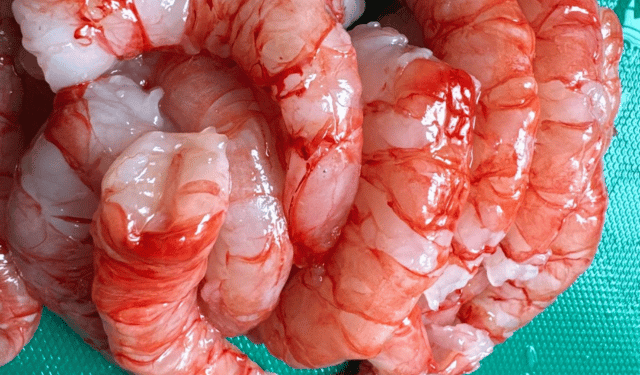
The answer lies in the biology of the species and in the environmental conditions in which they live. The Mediterranean red prawn, Aristaeomorpha foliacea, belongs to the Aristeidae family and is a species typical of great depths. It is this very species that made Mazara del Vallo’s deep-sea fleet famous on international markets. A different case is the red shrimp widely found in South American markets, such as the Argentine one, Pleoticus muelleri, which belongs to the Solenoceridae family.
These are, therefore, crustaceans that share a similar colour but belong to completely different biological and environmental contexts.
The Mediterranean red prawn generally lives and is caught at depths between 500 and 1,000 metres, in an environment characterised by high pressure, low temperatures and stable salinity. Under these extreme conditions, the species develops firm, intense flesh with pronounced iodine-rich notes, which have made it one of the most appreciated crustaceans in international fine dining.
Argentine red shrimp, by contrast, lives in much shallower waters, often between 50 and 200 metres. The environmental characteristics are completely different, and this is reflected in the texture of the flesh and in the organoleptic profile of the product, which is generally softer and has a higher water content.
This is not, therefore, a simple geographical variation of the same product. These are different crustaceans serving different market segments.
Unlike what happens in the South-West Atlantic, where resource availability is often tied to large-scale industrial fishing models focused on volume and supply standardisation, the fleet of Mazara del Vallo has built its reputation on a very different balance between fishing depth, product selection, onboard know-how and preservation capacity. This is not only a geographical difference, but also an economic one: on one side there is a commodity logic aimed at major international trade flows; on the other, a specialised deep-sea fishery that continues to base its value on species recognisability, onboard handling quality and the historic connection between product and territory.
The value of Mazara red prawn does not depend solely on the species being caught. Over time, a complex economic supply chain has developed around this product, one of the most structured in Mediterranean fisheries.
The vessels of the Mazara fleet are fishing boats designed for long offshore campaigns, often lasting several weeks. These are ships with steel hulls, advanced navigation systems and onboard processing facilities that make it possible to handle the product immediately after capture.
One of the defining features is freezing directly onboard, through blast-freezing systems that can reach temperatures of around -50°C. This technology preserves the cellular structure of the crustacean and keeps the organoleptic characteristics of the product intact until the moment of consumption.
Packaging at sea is another key element: the prawn that reaches restaurants in Milan, Tokyo or Dubai has often been handled exclusively by the crew that caught it.
Alongside fishing, there is also international logistics, specialised distribution, commercial intermediation and high-end gastronomy. Together, they form a value chain that turns a Mediterranean crustacean into a product recognised in gastronomic markets around the world.
The real issue in international competition is not the presence of other shrimp on the global market. The problem arises when the difference between species and origin is blurred in commercial communication.
In the seafood trade, this phenomenon is known as mislabelling or fish-sounding: the use of names that evoke more prestigious products in order to make less valuable references more attractive.
When a product is generically presented as “red prawn” without clearly distinguishing species and origin, the risk is that value is transferred from a structured territorial supply chain to a global commodity.
For this reason, safeguard clauses in international trade agreements are not perceived as a protectionist attitude, but as necessary tools to prevent price pressure generated by large-scale industrial production from squeezing products that operate in compliance with higher social, environmental and health standards.
Defending Mazara red prawn does not mean closing markets. It means recognising that quality comes with a cost of compliance.
European companies, in fact, operate within strict rules on food safety, environmental sustainability, traceability and working conditions. These rules protect consumers, but they inevitably affect production costs.
If the market stops distinguishing between a product of origin and an undifferentiated commodity, the risk is not only economic. It is also cultural.
Accepting that everything is simply “red prawn” would mean giving up the logic of territorial excellence that has built Italy’s gastronomic reputation around the world.
In the case of Mazara del Vallo, it would mean calling into question a maritime tradition that spans generations of fishermen and sea entrepreneurs.
Red prawn is not merely a price on the international market. It is an identity.
For more insights on the future of Italian and European fisheries and the blue economy, follow ongoing coverage and analysis on Pesceinrete.